Peptide Storage Space
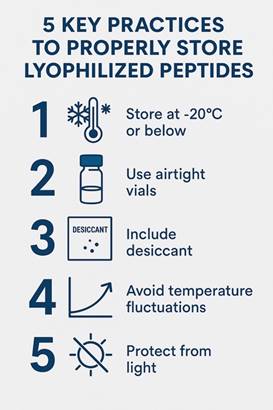
Storage And Handling Of Peptides Aapptec The life span of 10 vials of peptides depends entirely on storage space conditions and whether the vials have been opened. A typical 3mL peptide vial has a diameter of around 16-- 18mm and an elevation of regarding 40mm. Lyophilized peptides continue to be steady for extended durations when saved correctly. The vial is made to be opened only when the researcher is ready to reconstitute the peptide right into an option for experimental usage. Freeze-dried peptides may look secure, however they remain delicate.
What cancels out peptides?
Salicylic acid''s exfoliating activity may undercut the peptides, reducing their skin-repairing advantages. Recommendation: To avoid any type of communication, usage salicylic acid and peptide items at different times. For instance, include salicylic acid in your early morning regimen and peptides in your night routine.
Ideal Marketing Items
Lyophilization ideally "locks in" the peptide's framework by creating a glazed solid, yet any recurring dampness or excipients can affect security. The glass change temperature (T_g) of the dried cake has to remain well above storage temperature level; otherwise, the solid matrix can fall down. Lyophilized peptides are normally more stable than reconstituted products because water has actually been removed, which helps reduce some usual deterioration paths. Peptide storage issues due to the fact that temperature level, dampness, light, and handling can all affect material stability and honesty over time. Keep in mind that while basic guidelines apply to the majority of peptides, particular sequences might have one-of-a-kind needs. Once a peptide has been reconstituted, its handling demands become much more demanding due to the fact that water introduction lowers general stability. Peptides in remedy often tend to hydrolyze much more rapidly than in lyophilized, solid due to remedy response procedures, however are secure to some extent. For critical experiments requiring maximum peptide task, usage freshly reconstituted options whenever possible. Proper storage and handling of Kisspeptin-10 are crucial to preserving its biological activity and ensuring trusted research study results. This write-up gives useful support on ideal techniques for handling your Kisspeptin-10 supply. This web content is attended to educational and research advice purposes just.- Hydrolysis makes peptides generally unstable in aqueous services.
- Treatment must be taken, however, with the number of freeze-thaw cycles given that the exposure to ice crystals might disrupt the delicate peptide structure.
- Do not save frozen peptide remedies in a frost-free freezer.
- Extreme wetness, visible clumping, or sticky appearance shows incorrect storage space or seal failure.
Reference Materials: Improving The Harmonization Of Healthy Protein Measurements
Do not store icy peptide solutions in a frost-free freezer. Modifications like acetylation, amidation, cyclization, or incorporation of D-amino acids can substantially boost resistance to enzymatic destruction and chemical decay. If longer storage space is required, recombinant peptides can be iced up below -20 ° C, which can expand their security to numerous months. Store reconstituted peptides at fridge temperature level (2-8 ° C) for short-term usage. A lot of substances maintain acceptable strength for 3-8 weeks under refrigeration, though this varies by certain peptide. Numerous peptide series consist of amino acids prone to photo-oxidation. Tryptophan and tyrosine deposits are specifically prone to UV and visible light damages. Scent the Have a peek here remedy, as bacterial contamination creates off-odors. Reduced evident effectiveness without noticeable adjustments recommends undetectable degradation. When in doubt, throw out and change as opposed to running the risk of jeopardized research. For scientists maintaining peptide libraries or collaborating with materials that should last months to years, storage space optimization ends up being essential. This matters most for very water down solutions where peptide loss to surfaces stands for a significant percentage of complete product. Figures of benefit (e.g., LLOQ) of Tier 2assays are commonly identified by using various concentrations of unlabeledpeptide calibrators in spike-in experiments. Because pureness variesconsiderably among various vendors, crude peptides must also be analyzedby the lab developing peptide assays to guarantee enough high quality. Variable healing due to non-specific adsorption is one of the majorconsequences of inappropriate handling of peptides and can result in inaccuracy andbias (i.e., loss of peptide to Lyophilized Peptide surface areas or contamination/carryover). Therefore, there is presently noconsensus pertaining to the most effective carrier particles or the optimum concentration foruse with peptide inner requirement and calibrators. When reviewing carriermolecules, care needs to be taken to pick parts that do not interferewith discovery of the target peptide or excessively add to samplecomplexity or tool contamination. Because of this economy, a larger set of peptides can be selected and evaluated for growth of a proteinassay. Unrefined peptides (also referred to as partially purified peptides) aredefined as the deblocked peptides that have actually been released from the strong phaseresin and sped up with an organic solvent (e.g. ether). Some vendors willperform an extra purification step. A summary of standards for peptide selection exists in Table 1. Throughout peptide transport, prevent expanded durations at space temperature level or direct exposure to guide warm sources, which might lower shelf life of peptides substantially [5] Yes, lyophilized peptides should be saved at fridge freezer temperature levels (-20 ° C to -80 ° C )for long-lasting stability. Refrigeration (2-8 ° C) benefits much shorter durations up to months. Area temperature storage is acceptable throughout shipping and short handling however shouldn't prolong past a couple of days for optimum stability. Requirement or licensed recommendation materials have had their concentrationassigned by agreement or reference dimension procedure. Consensus-definedconcentrations use as various assay systems as possible (typicallyimmunoassays) to appoint the focus.